

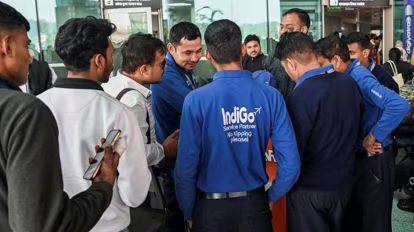
When India woke up to a wave of IndiGo cancellations and delays, the chaos felt almost surreal. Terminals were overflowing, passengers were stranded for hours, and social media was on fire with angry videos, emotional appeals, and frustrated rants. Yet beneath the visible commotion lay something even more unsettling, an open letter reportedly written by IndiGo crew and staff, circulating on multiple platforms, painting a picture of deeper structural issues within the airline and highlighting IndiGo Chaos Exposed.
At the same time, another narrative brewed online: the now-viral rumour that the aviation ministry had promised “normalisation in 3 days”. With no clarity on where the claim originated, passengers were left debating whether this crisis was a sudden operational failure, a predictable outcome of long-ignored staffing concerns, or something more coordinated, perhaps even a propagandistic push linked to new aviation policies.
To understand the IndiGo crisis, we need to piece together the factual fragments, the official statements, the crew’s grievances, and the rumours that have shaped public perception. The story is not as simple as a scheduling glitch or a temporary shortage. It is layered, emotional, and reflective of a system stretched thin.
The Day Everything Went Wrong
IndiGo, India’s largest airline by market share, typically operates thousands of flights a day. For an airline this size, minor delays are common. But in early December, the scale of disruption was unlike anything recent:
- Hundreds of flights were cancelled or severely delayed
- Crew availability dropped dramatically
- Passengers were left without real-time communication
- Airport terminals in metros saw long queues and rising tempers
While official data gradually emerged, passengers questioned the same thing:
“How can the country’s biggest airline collapse overnight?”
What made the crisis stand out was not the disruption itself, but the silence. For several hours, neither the airline nor the aviation authorities offered a clear explanation. That silence allowed speculation to explode.
The Crew’s Open Letter: A Cry From The Inside
Within 24 hours, screenshots of an alleged open letter from IndiGo crew and staff began circulating across Twitter, WhatsApp groups, LinkedIn, and Reddit. Though IndiGo did not officially confirm its authenticity, many aviation professionals and crew members acknowledged that the content was largely consistent with ongoing internal concerns.
Key Issues Alleged in the Open Letter
The letter highlighted several major problems:
1. Crew Fatigue and Unsustainable Rosters
Pilots and cabin crew claimed they were operating under exhausting duty schedules that barely met minimum rest norms.
One line from the letter, shared widely, read something like:
“We are humans, not machines. Safety cannot be guaranteed when exhaustion becomes routine.”
2. Pressure to Meet Aggressive Timelines
The letter alleged that the crew were pressured to operate tight turnarounds and had limited capacity to report fatigue without fear of repercussions.
3. Staffing Shortages
This is not new. India’s aviation industry has been battling:
- High attrition
- A surge in travel demand post-pandemic
- Increasing dependence on relatively newer crew
The letter suggested that IndiGo had been operating close to the edge for months.
4. “Punitive” Policy Changes
Some excerpts implied that internal policies had recently shifted in ways that made crew feel constrained, undervalued, or unheard.
5. A Call for Empathy and Reform
The open letter was less an attack and more a plea:
“We love flying. We love IndiGo. But we can’t fly safely under constant physical and emotional strain.”
The rawness of the message resonated with the public. Many travellers, previously annoyed at the airline, now felt empathy for the crew.
The Trigger: What Actually Caused the Meltdown?
Aviation experts pointed toward a combination of factors:
1. Crew Unavailability
A high percentage of staff reportedly called in citing fatigue.
This isn’t a strike, it’s a safety measure routinely protected under DGCA norms.
A fatigued pilot can legally refuse to fly.
2. Rostering System Strain
If even 10–15% of the crew become unavailable at short notice, a tightly scheduled airline collapses under its own complexity.
A single cancellation can trigger:
- Aircraft waiting for crew
- Crew waiting for aircraft
- Delays cascading throughout the network
This creates what experts call a rolling disruption spiral.
3. Seasonal Travel Pressure
December is one of India’s busiest travel months.
A breakdown at this time is felt more sharply and publicly.
4. Internal Morale Issues
The open letter indicated a deeper cultural fatigue, crew feeling overworked, undervalued, and unheard.
Such morale issues don’t appear overnight. They simmer.
The 3-Day Normalisation Claim: Where Did It Come From?
Soon after the disruption, social media erupted with claims such as:
- “Govt says everything will normalise in 3 days”
- “IndiGo will be back on track in 72 hours”
- “Ministry confident that operations will stabilise soon”
But when news outlets were checked, no official statement from the Aviation Ministry or DGCA directly mentioned a 3-day timeline.
So where did the rumour originate?
There are a few possibilities:
1. Misinterpretation of Regulatory Relief
DGCA temporarily relaxed certain night-duty limitations to improve roster flexibility.
Some outlets paraphrased this as “relief measures to help normalise operations soon,” which may have contributed to the 3-day rumour.
2. Social Media Amplification
A few influencers and aviation pages speculated that normalisation “could take around 72 hours.”
The statement mutated into a “government promise.”
3. Passenger Expectations
Travellers, desperate for clarity, may have repeated the claim enough times to give it legitimacy.
4. No Clear PR Response
IndiGo’s initial silence allowed the rumour to fill the information vacuum.
Bottom Line:
There is no verified evidence that the aviation ministry promised a concrete 3-day recovery timeline.
The rumour appears speculative, but it spread because people were hungry for answers.
Is the IndiGo Crisis Propaganda?
The word “propaganda” suggests deliberate manipulation.
Was this an organised attempt to shape public sentiment on aviation rules?
Here’s what can be reasonably said:
1. There are new policy changes
DGCA has been pushing for stricter crew-rest regulations and improved safety frameworks.
Airlines, especially low-cost ones, often struggle with tighter rest requirements.
2. Some aviation commentators suggested timing was “convenient”
Whenever there is operational stress, airlines sometimes highlight regulatory pressure as an indirect cause.
3. But: There is NO evidence of a coordinated propaganda agenda
The crisis is far more likely to be the result of:
- Structural fatigue
- Crew shortages
- Rostering pressure
- Peak-season demand
Policy changes may have contributed to stress, but the meltdown itself appears operational, not political.
Why Other Airlines Managed Better
A common public question has been:
“Why did Vistara, Air India, Akasa, and others not collapse the same way?”
1. Different Rostering Flexibility
Airlines have varying levels of buffer crew.
IndiGo’s massive scale means even small disruptions have huge chain effects.
2. Crew Mix and Attrition
Some airlines currently have a more stable crew-to-flight ratio.
3. Roster Planning Philosophy
Not all airlines push the same level of tight turnarounds or aggressive aircraft utilisation.
4. Operational Priorities
Low-cost carriers operate with very slim margins for error.
Full-service carriers often have slightly more slack in their network.
The Human Side of the Chaos
Behind every delayed flight was a passenger’s story:
- A family trying to reach a wedding
- A student returning to their hostel
- A businessman is missing a meeting that took months to arrange
- A sick passenger needing medical travel
Yet behind every cancelled flight was also a crew member:
- A pilot operating on little rest
- A cabin crew member dealing with back-to-back duty
- A scheduler trying to fill impossible gaps
- A young trainee is afraid to speak up
The open letter reminded people that crew are not robots.
They are human beings entrusted with lives, and their well-being is inseparable from passenger safety.
Where Does IndiGo Go From Here?
1. Rebuild Internal Culture
Crew morale needs urgent attention.
Listening, not just responding, is essential.
2. Improve Roster Safety
Rest hours must be respected not just on paper but in practice.
3. Strengthen Backup Systems
A larger standby crew pool may be expensive, but cheaper than mass cancellations.
4. Enhance Communication
Passengers felt abandoned because information was slow, vague, or absent.
Crisis communication needs significant strengthening.
5. Collaborate with Regulators
A constructive partnership, not conflict, will determine future stability.
The Road to Recovery
IndiGo will recover. The airline is too large, too embedded in India’s travel ecosystem, and too operationally experienced to remain broken for long.
But this crisis will be remembered as a wake-up call for the airline, the regulators, and the entire aviation community.
Also Read: IndiGo Crisis: Why So Many Flights Are Getting Cancelled
The open letter, whether officially acknowledged or not, reflects a deeper truth:
Aviation runs on teamwork, trust, and transparency.
When any of those weaken, even the strongest airline falters.
Frequently Asked Questions (FAQs)
1. What caused the IndiGo crisis?
A combination of crew unavailability, fatigue, rostering pressure, and high holiday-season traffic.
2. Is the open letter from IndiGo crew real?
It was widely circulated, and many employees confirmed the sentiment, though IndiGo hasn’t officially validated it.
3. Did the aviation ministry promise normalisation in 3 days?
No official statement confirms this. The claim appears to be a social media rumour.
4. Are new policies linked to the crisis?
New rest regulations may have added pressure, but the disruption seems largely operational, not political.
5. Will things get better soon?
Yes, IndiGo has received regulatory flexibility and is restoring schedules, though full normalisation may take time.