
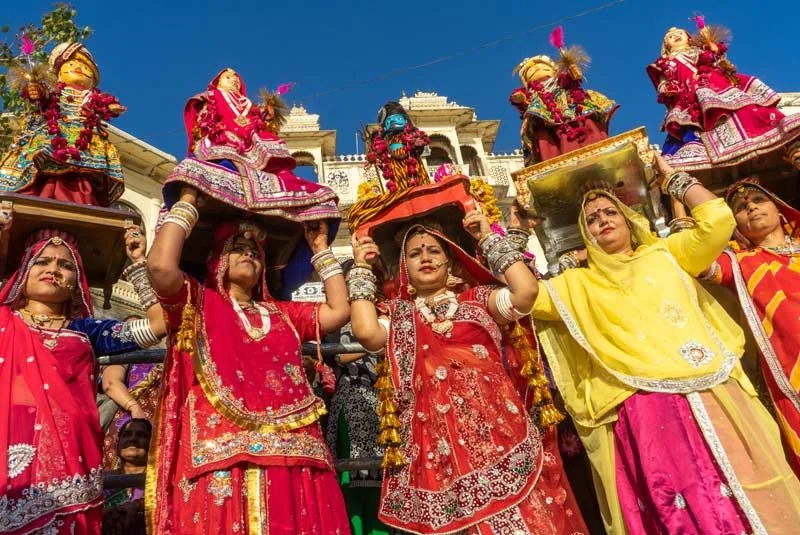
India is the land of colours and festivities. When it comes to the celebration of life, India truly leads the way. A union of many cultures, beliefs and traditions, India and its festivals are the best way for the people to express their emotions in the best suited way. They not only bring the opportunity to practice their traditional beliefs but also a jolly good reason to dress up in their traditional attire and enjoy belonging to the community under a common identity. One such festival is from the land of kings and warriors, Rajasthan, which goes by the name of “Gangaur”, also known as the “Royal Festival”. Primarily a festival dedicated to Gan, which means group in Sanskrit, is a warrior-like form of Shiva and Gaur, a form of Parvati as a royal bride.
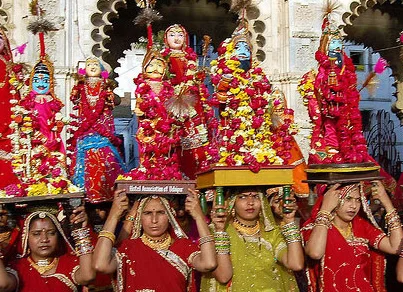
Marked beginning from the first day of Chaitra of the Indian calendar, i.e. the next day of Holika Dahan, it is an 18-day celebration dedicated to the marital bond of Shiva and Parvati and is highly regarded in the entire state of Rajasthan and neighbouring states like Uttar Pradesh, Madhya Pradesh, Punjab, Gujarat, formerly known as the erstwhile region of Rajputana. Similar events are also celebrated in the states of Maharashtra, Northern Karnataka and even West Bengal. This festival is celebrated on a grand scale by the former royal families of Rajasthan, especially in cities like Udaipur, Jaipur, Bikaner, Jodhpur and Jaisalmer.
The Historical and Cultural aspect of Gangaur
Considered as one of the most colourful and vibrant festivals of India, especially in Rajasthan, Gangaur is a very regal festival and is observed in the entire state with great devotion and fervour. Mainly a festival of marital and conjugal fidelity and blessing, it is also considered the harvest festival and marks the start of the summer season in Rajasthan. Mostly observed by married females, it is considered an important celebration for newly married couples, unmarried girls and couples wishing for childbearing.
Being the major festival of Rajasthan, it has a martial as well as regal influence on the event. Each major city of Rajasthan and its neighbouring states. Pre-independence, it was only celebrated by the royals and influential families on a grand scale and was attended by the common subjects. After independence and the abolishment of the aristocratic titles, it gained equal access outside the palaces and other people too started participating in the event and festival with equal enthusiasm.
Still, the public processions by many major royal families like Jaipur, Jodhpur and Udaipur are a big attraction and are a delight to watch. In fact, the state government of Rajasthan organises the major fairs and events like Gangaur Mahotsav and Mewar Mahotsav to commemorate the celebration and they are a major state affair.
The festive celebration of these events is not just a festival. It marks a major significance in the local beliefs and the socially traditional structure of the families in Rajasthan. An important event in the nuptial life of a couple in Rajasthan, the celebration of Gangaur inculcates many rituals and heritage practices that hold relevance in this modern era.
The legend behind the celebration of Gangaur
The most common folklore goes that once Shiva and Parvati decided to tour on earth in human form and were welcomed by the rich and poor with great warmth, offering them flowers, sweets and ornaments. Seeing their unwavering devotion and honour for the guests, Shiva and Parvati blessed the women and their families with good fortune, children, and prosperity.
After which Parvati took a bath in a river and worshipped Shiva in the form of Lingam. Shiva appeared before her and blessed her with the boon that whoever observes the fast and worships the divine couple in the form of Gan and Gaur will enjoy lasting marriages and good health for the family.
How and when is Gangaur celebrated?
Gangaur, as mentioned above, is celebrated in remembrance of the marital life of Shiva and Parvati. The 18-day celebrations start from the first day of Chaitra month, marking its start from the next day of Holi, the festival of colours. For a newly married woman and those who are seeking childbirth, it is required to observe 18 days of fasts and special worship of the Gana, i.e. Shiva and Gaur, the consort of Shiva.
The fast ends on the 3rd day of the Shukla paksha (New moon phase) of the month of Chaitra. Many folklores and strong traditional practices are associated with this observation of the fasts and it is a major matriarchal event in Rajasthan as well as India. The women create the wooden or clay statues of Gan and Gaur, decorating it with paints, colourful cloths and jewellery.
During the course of 18 days of fasting and celebrations, the women in the house sing, dance and prepare scrumptious feasts to be first offered to the statues and then shared and consumed by oneself and the family. Their hands and feet are decorated with the Mehnadi (paste of the leaves of Lawsonia Inermis plant).
Also Read: Forgotten Languages of India: The Fight for Recognition
On the 7th day of the festival, the unmarried girls carry an earthen pot on their head with a burning lamp within and collect presents in the form of money, sweets and even flour and Ghee (clarified butter). On the 10th day, these pots are broken and a feast is made using the presents gathered on the 7th day. On the climax of the event, in the last 3 days, the statues are richly decorated with new cloths and jewellery, made especially for the day. They are also extensively adorned with flowers and garlands, making them feel like a living figure.
In the afternoon, the statues are placed on a pedestal, carried on the head of married women and the procession is taken to a river, lake or pond where water is offered to the statues. The women, all dressed richly in marriage attire, sing and dance to songs of Parvati’s departure to Kailash with Shiva after their marriage and about their married life.
Also Read: Sarees That Are UNESCO Protected: Why It Matters
On the final day, the clay statues are immersed in the water, marking the end of the fortnight-long festive event. Places like Jaipur and Udaipur, which have the best Gangaur celebration in India. In fact, Udaipur has a ghat named after the celebration of Gangaur, on Lake Pichola.
Frequently Asked Questions (FAQs)
Q1. Is the Teej and Gangaur the same?
No. While Teej is celebrated in the month of Shravan (July – August) Gangaur is celebrated in the month of Chaitra (March- April).
Q2. Can unmarried girls worship and celebrate Gangaur?
Yes. Unmarried girls can worship and celebrate Gangaur as it is believed to bless them with a good married life.
Q3. Is it necessary to observe fast for 18 days?
Though it is mentioned in the folklore, it is not mandatory to observe the fast of 18 days of the Gangaur celebration.
Q4. Which city has the best Gangaur procession?
Every city of Rajasthan has their own royal Gangaur procession, which is unique in its own way. However, the procession of Udaipur and Jaipur is considered the best to watch.
Q5. Where will Gangaur be observed in Udaipur?
The major celebration of Gangaur in Udaipur will be celebrated on the Gangaur Ghat of Lake Pichola and is a grand spectacle to watch.