
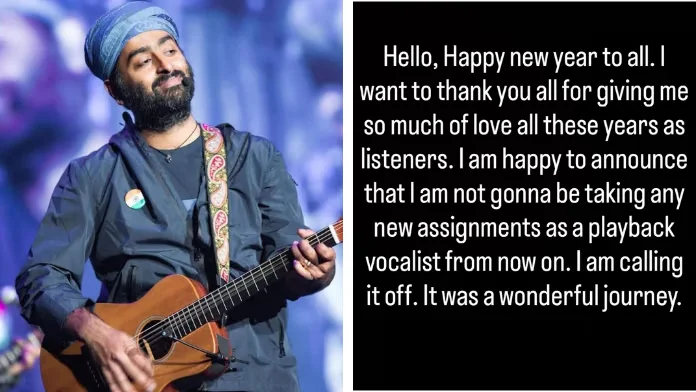
When Arijit Singh sings, India listens.
In cabs stuck in traffic, at weddings where emotions spill over, in late-night headphones and early-morning alarms, his voice has become less of a soundtrack and more of a shared emotional language. That is why the news landed like a quiet earthquake.
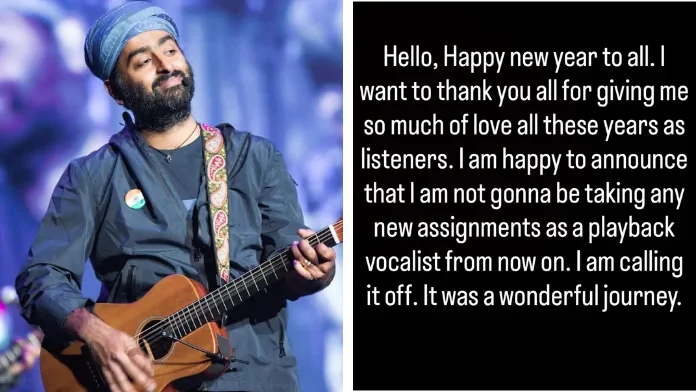
In January 2026, Arijit Singh announced that he is retiring from playback singing for films.
Not slowing down.
Not taking a break.
Not experimenting on the side.
Retiring.
Within minutes, social media turned into a collective gasp. Fans spoke in disbelief. Industry insiders scrambled for meaning. Some mourned as if an era had ended. Others asked a sharper question: Why would the biggest singer of his generation walk away at the peak of his powers?
The answer is layered, uncomfortable, and deeply revealing about the state of Bollywood music today.
The Announcement That Froze Bollywood Mid-Verse
Arijit Singh’s announcement was characteristically understated. No dramatic press conference. No tear-soaked farewell concert. Just a clear message shared publicly: he would no longer accept new playback singing assignments for films.
The phrasing mattered.
He was not quitting music.
He was not retiring from singing altogether.
He was stepping away from the machinery of Bollywood playback.
And that distinction changes everything.
Playback singing, once considered the highest artistic calling in Indian cinema, has increasingly become a factory process. Songs are commissioned, altered, rearranged, auto-tuned, remixed, and re-released at a speed that leaves little room for emotional depth. For a singer whose entire appeal lies in sincerity and vulnerability, that system can feel suffocating.
From Reality Show Contestant To A Once-In-A-Generation Voice
To understand the shock of Arijit’s decision, one must revisit the scale of his dominance.
Arijit Singh did not rise slowly. He arrived like a monsoon.
From “Tum Hi Ho” to “Channa Mereya”, from “Agar Tum Saath Ho” to “Kesariya”, his voice defined heartbreak, longing, surrender, and quiet joy for more than a decade. He became the default emotional narrator for Hindi cinema.
By the mid-2020s, he was everywhere.
Too everywhere, some would argue.
Multiple films per month.
Versions upon versions of the same emotional ballad.
Remixes chasing virality rather than meaning.
What once felt intimate began to feel repetitive. Not for listeners, perhaps, but for the man behind the microphone.
“I Got Bored”: The Sentence That Said More Than It Seemed
When Arijit explained his decision, one sentence stood out and unsettled many:
“I got bored.”
In an industry that glorifies burnout as success, boredom is treated like ingratitude. But in creative professions, boredom is often the first symptom of stagnation.
Arijit has hinted that playback singing had turned into repeating emotional templates. The songs changed names, the films changed faces, but the demands remained identical. Sing heartbreak. Sing longing. Sing redemption. Again.
Even live performances became exercises in rearrangement rather than reinvention.
For an artist who trained in classical music and respects musical discipline deeply, this cycle can feel hollow.
The Exploitative Side Of Bollywood’s Music Machine
Arijit’s retirement has also forced an uncomfortable conversation about how Bollywood treats its singers.
Unlike actors, playback singers rarely control their output. They are paid per song. They have little say in final edits. Their voices are reused, remixed, altered, and sometimes replaced without consultation.
In recent years, the rise of algorithm-friendly music has worsened this imbalance. Songs are increasingly designed for reels, not resonance. Short hooks matter more than melodic journeys.
Arijit Singh, ironically, became a victim of his own success. His voice was safe. Bankable. Predictable.
And predictability is poison for creativity.
Also Read: Why Fans Feel Part of Taylor Swift’s Engagement Journey
A Fanbase Bigger Than The Industry Can Contain
Another paradox: Arijit Singh may have outgrown Bollywood itself.
By 2025, his global streaming numbers rivalled international pop stars. His concerts sold out across continents. His fanbase extended far beyond Hindi cinema.
Yet playback singing kept him tied to scripts, release dates, studio politics, and marketing strategies.
Stepping away allows him to reclaim something precious: autonomy.
Independent music, classical collaborations, spiritual compositions, regional explorations. These are not commercially convenient for Bollywood, but they are artistically nourishing.
Making Space For New Voices, Or For Himself?
Arijit also mentioned wanting to make space for younger singers.
On the surface, it sounds generous. But beneath it lies a deeper truth: Bollywood has been recycling voices instead of nurturing diversity.
For years, producers defaulted to Arijit even when a song demanded a different texture. This crowded out emerging talent and trapped Arijit in a golden cage.
By stepping away, he disrupts that dependency.
It is not an exit. It is a reset.
Why This Feels Like The End Of An Era
Playback singing once had giants who stayed until their voices aged naturally into wisdom. Lata Mangeshkar, Kishore Kumar, Mohammed Rafi. Their longevity was tied to an industry that valued patience and melody.
Today’s industry moves faster, consumes harder, and discards quicker.
Arijit’s retirement feels symbolic because it marks the moment when a sensitive artist chose preservation over exhaustion.
He did not wait to be irrelevant.
He did not wait to be overused beyond recognition.
He stepped back while his voice still meant something.
That is rare.
What Bollywood Loses Without Arijit Singh
Bollywood does not lose just a singer. It loses emotional shorthand.
Arijit’s voice could convey regret in a single breath. His silences were as powerful as his notes. He made vulnerability commercially viable in a hyper-masculine industry.
Without him, filmmakers will have to work harder. Music directors will have to think differently. And audiences may, finally, hear new textures.
Loss can be fertile ground.
What Arijit Singh Gains By Walking Away
Freedom.
The freedom to sing without deadlines.
To release music without box-office pressure.
To explore ragas, folk traditions, experimental soundscapes.
To fail quietly and succeed honestly.
Arijit Singh retiring from playback is not a disappearance. It is a re-emergence on his own terms.
Not An Obituary, But A Rewriting
Some have treated this announcement like a funeral. Fellow singers have urged fans not to.
This is not an obituary.
It is a boundary.
Arijit Singh has drawn a line between art and assembly line, between expression and extraction.
And in doing so, he has asked Bollywood an uncomfortable question: What happens when your most reliable voice no longer wants to play the same tune?
Silence As A Statement
In a world that equates constant output with relevance, choosing silence or selective speech becomes radical.
Arijit Singh’s retirement from playback singing is not about exhaustion alone. It is about dignity, creative survival, and the courage to leave a party while the music is still good.
His voice will not vanish.
It will simply no longer arrive on cue.
And perhaps that makes it even more powerful.
Frequently Asked Questions (FAQs)
Q1. Has Arijit Singh completely retired from music?
No. He has only retired from playback singing for films and will continue making independent music.
Q2. When did Arijit Singh announce his retirement?
He announced it publicly in January 2026.
Q3. Why did Arijit Singh quit playback singing?
He cited creative boredom, a desire to return to his musical roots, and dissatisfaction with repetitive industry practices.
Q4. Will Arijit Singh still perform live concerts?
Yes. He is expected to continue live performances and independent releases.
Q5. How will this affect Bollywood music?
It may force the industry to diversify voices, rethink creative dependence, and move away from formula-driven music.