

When Donald Trump said “whole civilisation will die,” the phrase did not remain confined to a political speech. It slipped into timelines, dinner table conversations, and quiet late-night thoughts. In an age where information travels faster than reflection, such words can feel heavier than they are meant to be. For many, it sparked a subtle unease, a sense that the systems we rely on might not be as permanent as we once believed. And that feeling, however fleeting, changes how we think about everyday life.
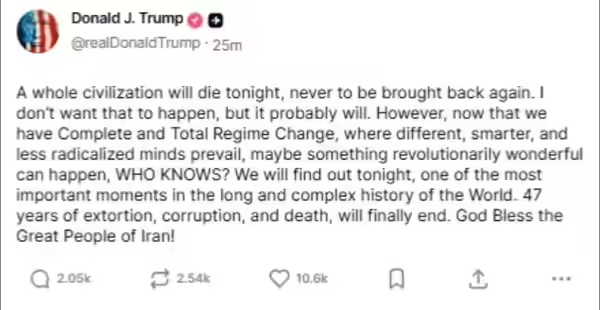
This is not just about politics. It is about perception, behaviour, and the curious way dramatic language reshapes our daily decisions. From the products we buy to the technology we trust, fear can quietly influence our choices without us even noticing. So what happens when a statement like “whole civilisation will die” becomes part of the background noise of modern living? More importantly, how do we stay grounded in a world that occasionally sounds like it is teetering on the edge of collapse? That is precisely what makes this conversation worth exploring.
The Psychology Of Dramatic Statements
There is something undeniably magnetic about a sentence like “whole civilisation will die.” It feels absolute, almost cinematic, as though reality has briefly borrowed the script of a dystopian film. Psychologically, humans are wired to respond to threats faster than reassurances. It is an evolutionary instinct that once kept us safe, and today it keeps us glued to headlines. The mind does not pause to analyse immediately. Instead, it reacts, imagines, and sometimes exaggerates. This is why dramatic political language travels so quickly. It taps into something primal, something that transforms curiosity into concern within seconds.
The Role Of Technology In Amplifying Fear
Technology does not create fear, but it certainly knows how to amplify it. Social media platforms, news apps, and algorithm-driven feeds act like echo chambers, repeating and reshaping statements until they feel larger than life. A phrase like “whole civilisation will die” can appear in dozens of formats within minutes, each one adding a slightly different emotional tone. Over time, this repetition creates a sense of urgency that may not have existed initially. Interestingly, the same technology that spreads anxiety also offers solutions. From digital detox apps to curated news platforms, consumers are now actively seeking ways to control what they consume.
Also Read: New Wage Rule Explained: Will Your In-Hand Salary Reduce Under India’s Labour Codes?
Lifestyle Shifts In An Age Of Uncertainty
When uncertainty enters the room, lifestyle quietly rearranges itself. People begin to prioritise stability, comfort, and predictability. This might show up as choosing simpler routines, investing in health, or even rethinking long-term plans. There is also a noticeable shift towards mindfulness practices, as individuals attempt to counterbalance the noise around them. While dramatic statements like “Whole Civilisation Will Die” may not directly change behaviour overnight, they contribute to a broader atmosphere of caution. And in that atmosphere, even small decisions begin to carry a little more weight than usual.
Consumer Behaviour And The Rise Of Practical Choices
Fear, even in its mildest form, tends to nudge consumers towards practicality. Instead of impulsive purchases, there is a growing preference for items that offer utility and longevity. Essentials gain importance, while luxury becomes more considered. This does not mean people stop spending, but rather that they spend differently. Brands that emphasise reliability, sustainability, and value often benefit in such environments. It is almost as if the market itself becomes more thoughtful, mirroring the cautious mindset of its consumers.
Finding Balance Between Awareness And Anxiety
Living in a world where dramatic statements like “Whole Civilisation Will Die” circulate freely requires a certain level of emotional discipline. It is important to stay informed, but equally important to avoid becoming overwhelmed. This balance is not always easy to achieve, especially when headlines compete for attention with increasing intensity. One practical approach is to limit exposure to repetitive content and focus on verified, credible sources. Another is to consciously engage in activities that ground you in reality, whether that means spending time offline or simply stepping away from the constant stream of updates.
Also Read: What is Empty Nest Syndrome?
The phrase “whole civilisation will die” may sound like a final chapter, but in reality, it is just another line in an ongoing story. While such statements can feel overwhelming, they also remind us of the importance of perspective. Civilisation is not as fragile as it sometimes appears, nor is it immune to change. The key lies in how we respond, not just as individuals but as a collective. By staying informed, thinking critically, and making mindful choices, we can navigate uncertainty without losing our sense of balance and direction in everyday life.
Frequently Asked Questions (FAQs)
Q1. What did Donald Trump mean by “whole civilisation will die”?
The statement is widely seen as a dramatic expression rather than a literal prediction. It is often used to emphasise urgency around specific issues rather than forecast an actual collapse of civilisation.
Q2. Should people be worried about civilisation collapsing?
While global challenges exist, there is no immediate evidence suggesting total collapse. Civilisation has shown resilience and adaptability throughout history.
Q3. How do such statements affect everyday people?
They can create anxiety or influence perception, especially when repeated across media platforms. Over time, they may also shape consumer behaviour and lifestyle choices.
Q4. Why do political leaders use dramatic language?
Dramatic language captures attention and simplifies complex issues. It can make messages more impactful, though sometimes at the cost of nuance.
Q5. How can individuals stay balanced in such situations?
Limiting exposure to repetitive news, focusing on credible sources, and maintaining healthy routines can help. It is important to stay informed without becoming overwhelmed.