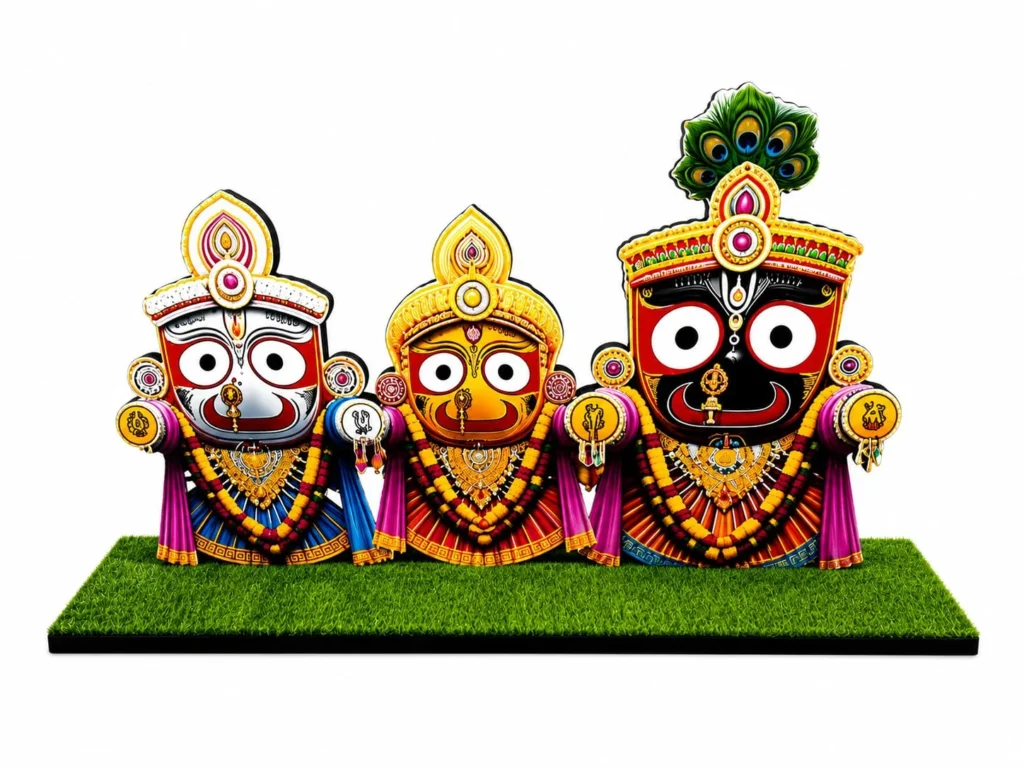
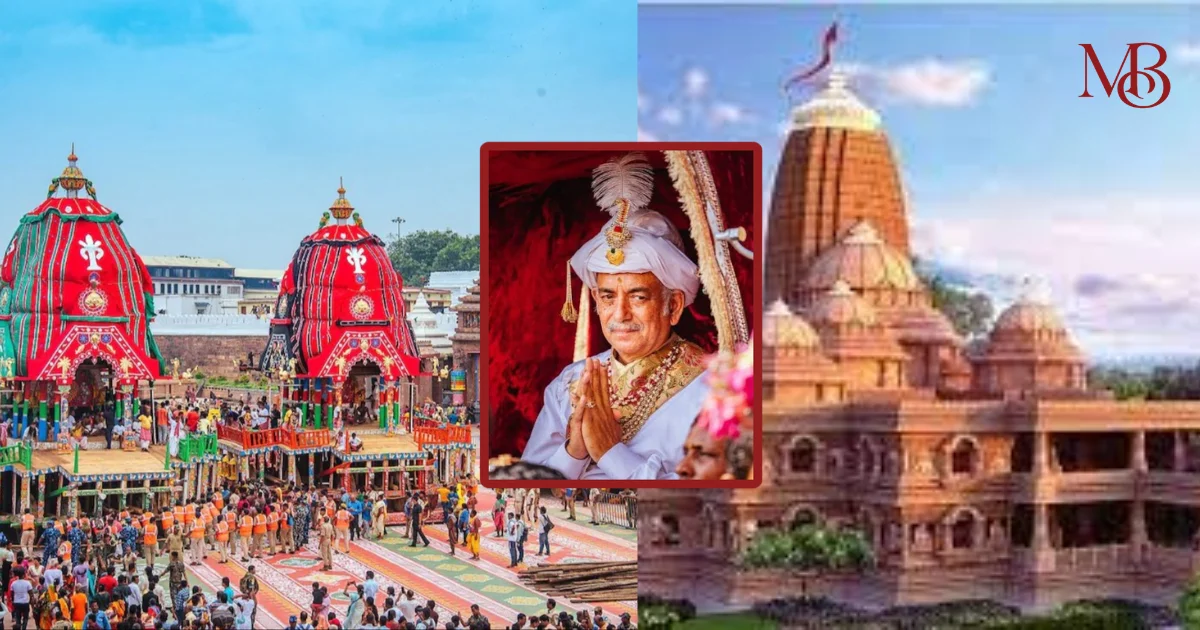
For millions of devotees across the world, Lord Jagannath’s Rath Yatra is far more than a religious procession it is a symbol of faith, tradition, and divine connection. Every year, the streets of Puri in Odisha transform into a sea of devotion as devotees gather to witness one of Hinduism’s most revered festivals. At the same time, the International Society for Krishna Consciousness (ISKCON) organises hundreds of Rath Yatra celebrations in cities across the globe, introducing Lord Jagannath to millions of people outside India. Yet, what appears to be a shared celebration of devotion has become the centre of an increasingly visible dispute: “Puri Raja vs ISKCON”.
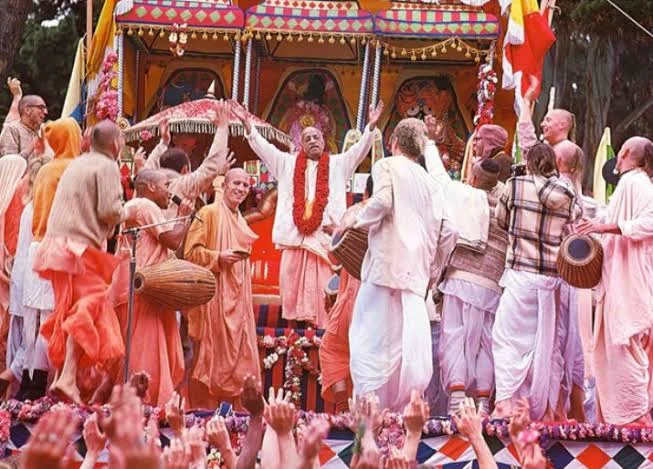
In recent months, a disagreement between the Puri Gajapati Maharaja, commonly referred to as the Puri Raja and ISKCON has sparked intense debate among devotees, scholars, and religious institutions. The controversy has raised fundamental questions about who has the authority to define religious traditions, whether centuries-old customs can adapt to a global audience, and how sacred rituals should be preserved in an interconnected world.
This dispute is not about opposing Lord Jagannath. Instead, it is about preserving ritual authenticity while balancing the practical realities of celebrating a centuries-old tradition across different countries and cultures.
Who Is Puri Raja?
The title “Puri Raja” refers to the Gajapati Maharaja of Puri, whose royal lineage has been closely associated with the Jagannath Temple for centuries.
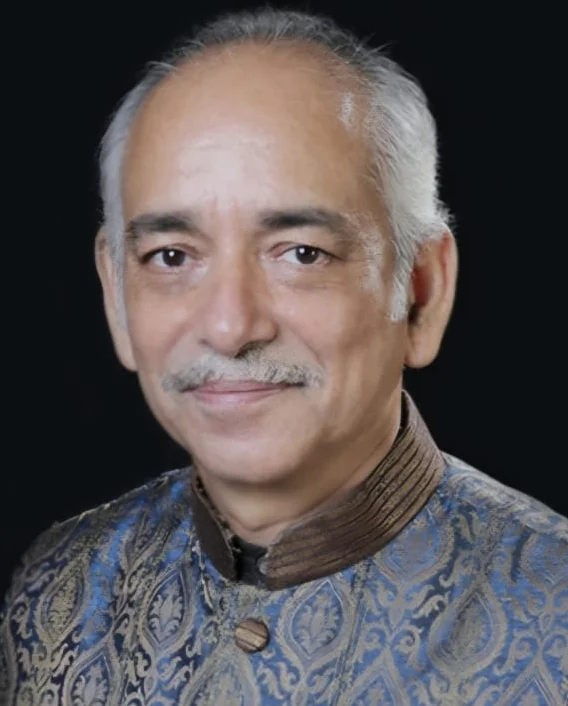
Although the monarchy no longer holds political power, the Gajapati Maharaja continues to serve as the Adyasevak, or the foremost servitor of Lord Jagannath. This role is deeply respected within the Jagannath tradition, making the Raja the ceremonial guardian of temple customs and rituals.
Today, Gajapati Maharaja Dibyasingha Deb oversees the preservation of rituals that have been followed for generations according to temple scriptures and long-established traditions.
Why Is ISKCON Involved?
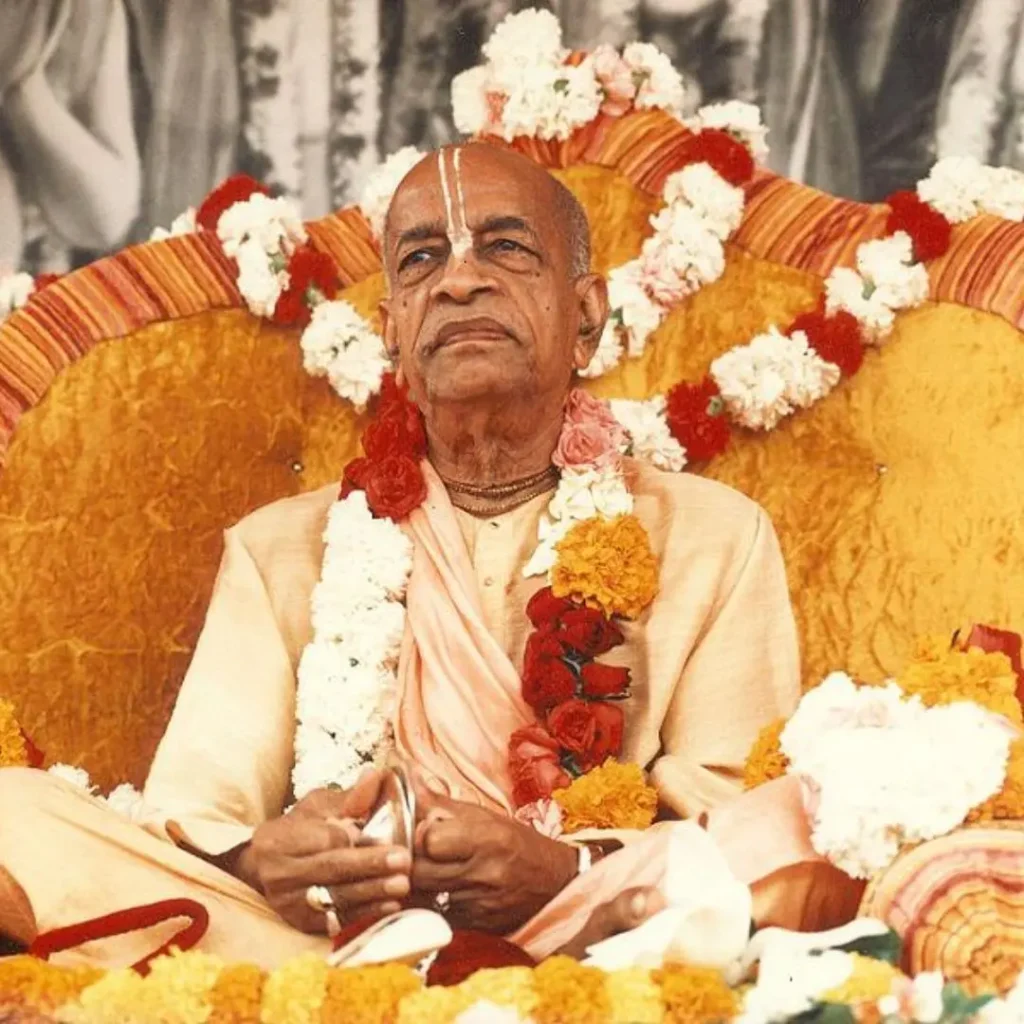
Founded in 1966 by A.C. Bhaktivedanta Swami Prabhupada, ISKCON has played a significant role in spreading Krishna consciousness worldwide.
One of the organization’s most recognizable traditions is the public Rath Yatra festival, inspired by the famous procession in Puri. Every year, ISKCON conducts hundreds of Rath Yatras in countries including the United States, the United Kingdom, Australia, Russia, South Africa, and many others.
These festivals have introduced millions of people to Lord Jagannath, often becoming major cultural events attended by both devotees and the general public.
However, the very global nature of these celebrations has also become the source of controversy.
What Triggered the Dispute?
The primary disagreement concerns the timing of the Rath Yatra and certain related festivals, including Snana Yatra. According to the Jagannath Temple tradition in Puri, these festivals must be observed strictly according to specific lunar dates (tithis) mentioned in sacred scriptures. Temple authorities argue that changing these dates, even for practical reasons, alters the sanctity of the festival.
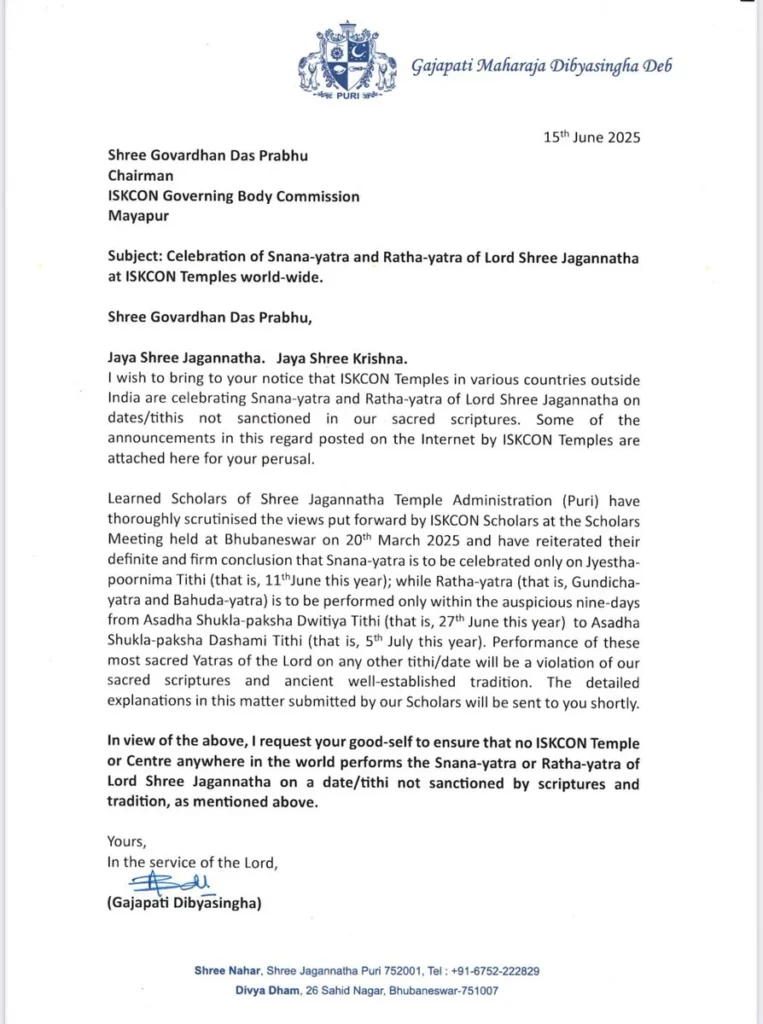
ISKCON, on the other hand, often schedules international Rath Yatras on weekends or public holidays to ensure maximum public participation. From ISKCON’s perspective, logistical realities make it difficult to organize large public processions on exact lunar dates in every country. Obtaining police permissions, securing municipal approvals, arranging volunteers, and ensuring public attendance often require flexibility in scheduling.
This difference in approach has become the heart of the controversy.
The Puri Temple’s Stand
The Jagannath Temple administration believes that the original Puri tradition represents the authentic and scripturally sanctioned practice. Temple authorities have argued that celebrating Rath Yatra or Snana Yatra on dates different from those prescribed by the traditional Hindu calendar may confuse devotees and gradually weaken the religious significance attached to these rituals.
The Puri Raja has repeatedly emphasized that Jagannath traditions are not merely symbolic events but sacred rituals governed by established scriptures, temple records, and centuries of uninterrupted practice. According to temple officials, maintaining ritual precision is essential for preserving the spiritual identity of Lord Jagannath’s worship.
Reports indicate that the Gajapati Maharaja has also written to constitutional authorities, seeking intervention to protect what he considers the original traditions of the Jagannath cult.
ISKCON’s Perspective
ISKCON maintains that its objective is not to alter Jagannath traditions but to spread devotion worldwide. The organization argues that public participation is itself an important aspect of Lord Jagannath’s message.
According to ISKCON leaders, organizing Rath Yatras on weekends or national holidays enables significantly larger gatherings, allowing more people to experience the festival.
ISKCON also points out that many of its festivals are conducted with elaborate rituals, devotional chanting, and scriptural observances despite being held on adjusted dates.
The organization believes that flexibility in scheduling does not diminish devotion. Instead, it considers these adaptations necessary to introduce Lord Jagannath’s teachings to global audiences who live under entirely different civic and administrative systems.
Also Read: The Viral Baby Elephant Photo Taking Over The Internet: Why Everyone Is Talking About It
Tradition Versus Global Expansion
At its core, the controversy reflects a broader question faced by many religious traditions in the modern world. Can sacred customs evolve when they cross geographical and cultural boundaries?
Religious institutions have often encountered this dilemma throughout history. Many ancient traditions developed in specific local contexts, where rituals could follow precise calendars and community customs.
Global organizations, however, must work within legal systems, public event regulations, school calendars, weather conditions, and administrative requirements that differ from country to country.
For ISKCON, adapting dates is seen as a practical necessity. For the Puri temple, altering dates risks weakening the authority of centuries-old religious practices. Neither side questions the importance of Lord Jagannath. Instead, they differ on how sacred traditions should be maintained in today’s global environment.
Why Timing Matters So Much
To an outside observer, changing a festival date by a few days may seem insignificant. Within Hindu ritual traditions, however, timing often carries profound spiritual meaning. Many ceremonies are performed according to lunar calculations believed to align with specific cosmic and religious principles.
The Jagannath Temple follows an intricate ritual calendar that governs nearly every ceremony conducted throughout the year. Temple scholars argue that the sanctity of these rituals depends not only on how they are performed but also on when they are observed.
This explains why the temple administration considers deviations from prescribed dates a serious concern rather than a minor scheduling issue.
Is This a Legal Dispute?
So far, the disagreement remains primarily a religious and institutional matter. While there have been discussions about possible legal remedies, the issue has largely unfolded through public statements, letters, and appeals made by both sides.
Temple authorities have urged ISKCON to follow traditional festival dates more closely.
ISKCON, meanwhile, has defended its position while indicating that its global celebrations are intended solely to promote devotion to Lord Jagannath and Lord Krishna. Both organizations continue to enjoy enormous respect among devotees worldwide.
How Devotees View the Issue
Interestingly, many devotees find themselves respecting both sides. Those closely associated with the Jagannath Temple often support preserving traditional rituals exactly as they have been practiced for centuries.
Others appreciate ISKCON’s role in introducing Jagannath worship to countries where very few people had previously heard of the deity. For countless devotees, the dispute is not about choosing one side over the other. Instead, they hope for dialogue that protects ancient traditions while allowing devotional outreach to continue globally.
The Bigger Picture
The debate extends beyond one festival. It reflects a larger conversation taking place within many religious communities worldwide. As faith traditions become increasingly global, institutions must decide how much adaptation is acceptable without compromising authenticity.
The Jagannath tradition occupies a unique place in Indian spirituality because of its extraordinary continuity over hundreds of years. At the same time, ISKCON’s international movement has introduced millions of people to Lord Jagannath through festivals, temples, books, and cultural programs.
Both contributions have shaped modern devotion in different ways. The challenge lies in finding common ground that respects historical traditions while recognizing the realities of global religious practice.
What Lies Ahead?
Whether the dispute ultimately leads to a formal agreement or continues as an ongoing theological difference remains uncertain. Many observers believe that constructive dialogue between the Jagannath Temple administration and ISKCON could help reduce misunderstandings and establish clearer guidelines for international celebrations.
For devotees, the hope is that the focus remains on the spirit of Lord Jagannath’s teachings, compassion, unity, and devotion. While debates over ritual practice may continue, the shared reverence for Lord Jagannath remains the strongest bond connecting both institutions.
As the conversation evolves, one fact remains undeniable: the Rath Yatra continues to inspire millions around the world, proving that Lord Jagannath’s message has transcended borders, languages, and cultures. The current controversy is therefore not merely a dispute over dates, it is a reflection of the ongoing challenge of preserving sacred traditions in an increasingly globalized world.
Frequently Asked Questions (FAQs)
1. Why are the Puri Raja and ISKCON in conflict?
The main disagreement is over the timing of Rath Yatra and related festivals. The Puri temple insists on observing the exact lunar dates, while ISKCON sometimes adjusts dates to accommodate international logistics.
2. Does the dispute involve differences in worship?
No. Both the Puri Jagannath Temple and ISKCON worship Lord Jagannath. The disagreement concerns ritual practices and festival scheduling, not the deity or core beliefs.
3. Why does ISKCON organize Rath Yatras on different dates?
ISKCON says international events often require flexibility due to government permissions, weekends, public holidays, weather conditions, and volunteer availability.
4. What role does the Puri Raja play in the Jagannath Temple?
The Puri Raja, officially known as the Gajapati Maharaja, serves as the Adyasevak (chief servitor) of Lord Jagannath and is regarded as the guardian of the temple’s traditional rituals.
5. Has the dispute affected the Rath Yatra celebrations?
No. Both the Jagannath Temple in Puri and ISKCON continue to conduct Rath Yatra celebrations. The debate is primarily about maintaining traditional practices versus adapting them for global audiences.