
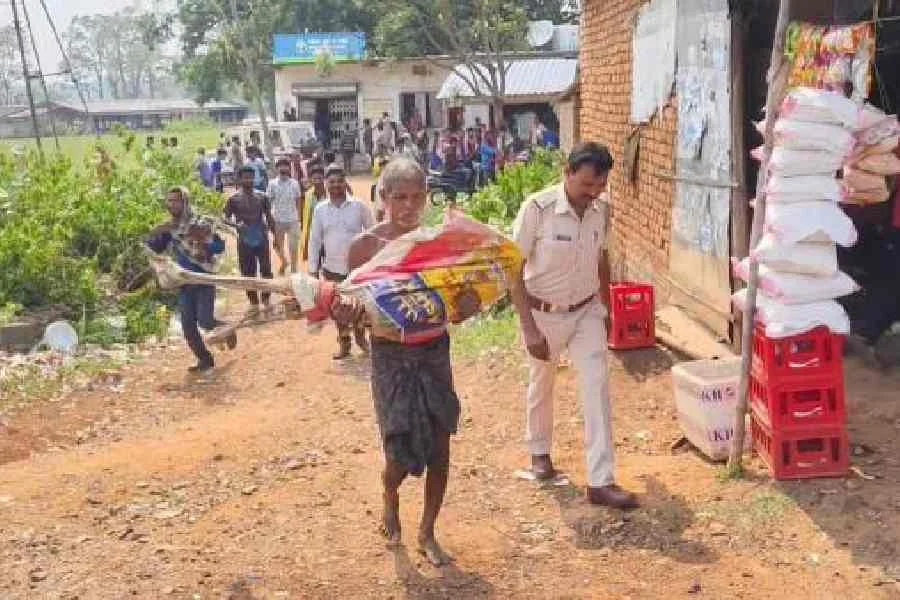
The Keonjhar incident is a case that has sparked widespread discussion on administrative access and procedural clarity, a man from Keonjhar district allegedly exhumed the remains of his deceased sister and carried them to a bank in an attempt to withdraw money from her account. The amount involved was reportedly modest, around ₹19,000 to ₹20,000, but the process of accessing it had become increasingly complicated due to missing documentation required under banking rules. What might appear at first as an isolated and shocking incident is now being examined more closely as a breakdown that sits at the intersection of banking compliance, civil documentation, and public awareness.

A Small Amount Of Money, A Large Administrative Barrier
According to officials familiar with the matter, the bank had refused to release the funds because the required documents were not in place. In India, when an account holder dies, banks are legally required to verify the death through official documentation before allowing any withdrawal or transfer of funds.
This typically includes a government-issued death certificate and proof establishing the legal heir or nominee. These safeguards exist to prevent fraud and ensure that financial assets are released only to the rightful claimant. However, in this case, the process reportedly stalled at the documentation stage.
While the bank maintained that it was following standard procedure, the absence of completed paperwork meant that the funds remained inaccessible.
Where The Process Begins To Break In Practice
On paper, the process is straightforward. A death is registered, a certificate is issued, and the banking system updates its records accordingly. In reality, however, this chain depends heavily on timely reporting, administrative efficiency, and public understanding of how the system works.
In rural areas, delays in death registration are not uncommon. Sometimes the death is reported late. Sometimes the family is not fully aware of the steps required. In other cases, the documentation process simply takes longer due to administrative workload or distance from issuing offices.
This creates a gap between what the system expects and what individuals are able to produce at a given time. And in that gap, access to financial resources becomes suspended.

A Literal Interpretation Of A Procedural Requirement
Local reports suggest that the man had made repeated attempts to complete the formalities required to access the funds. Each attempt, however, reportedly ended with the same requirement: submit proper documentation.
At some point during this process, the requirement for “proof of death” appears to have been interpreted in a literal sense. The man allegedly exhumed his sister’s remains and brought them to the bank as proof that she had died.
There is no indication that any bank official had requested physical proof of death, and officials have stated that they followed standard verification procedures throughout. The act, however, immediately escalated the situation and required intervention from local authorities.
Bank’s Position: Procedure, Not Discretion
Bank officials have maintained that they were bound by regulatory requirements and that their role in such cases is strictly procedural. Without a death certificate and legal heir documentation, they are not permitted to release funds from a deceased account.
From the institution’s perspective, deviation from these rules would expose the system to fraud risks and legal complications. The bank has also clarified that no instruction was given to provide physical proof of death and that all communication was consistent with standard documentation requirements.
Administrative Systems That Do Not Always Align
The incident highlights a less visible issue: the way different administrative systems depend on one another without always operating at the same speed.
The banking system relies on the civil registration system to confirm death. The civil registration system depends on timely reporting and procedural completion. The public depends on both systems functioning in a way that is understandable and accessible.
When any part of this chain slows down, the impact is not abstract. It becomes immediate and personal. In this case, access to a small financial amount became blocked not by denial, but by procedural incompleteness.
Intervention And Resolution
Following the incident, authorities intervened to bring the situation under control. Officials later assisted the family in completing the required documentation process. Once the necessary paperwork was finalised, the funds were reportedly released. Authorities have not confirmed whether any legal action will be taken in connection with the exhumation.

A System That Worked, And Didn’t Work At The Same Time
On a technical level, each part of the system appears to have functioned as designed. The bank followed procedure. The civil system eventually issued documentation. The administrative response ensured resolution. But the outcome still raises a difficult question: what happens when systems are correct individually, but unclear collectively?
Because for the person navigating them, the experience is not segmented into institutions. It is one continuous process of trying to reach a solution. And in this case, that process collapsed into an act that reflects not just desperation, but misinterpretation of how the system speaks.
When Procedures Exist But Clarity Does Not
The Odisha incident is not being framed as a failure of a single institution. Instead, it reflects a broader issue of procedural distance, the gap between how systems are designed and how they are understood at the ground level. While regulations around banking and documentation are clear in structure, their accessibility depends on awareness, communication, and timing. When those elements do not align, the result is not necessarily wrongdoing. Sometimes, it is confusion that escalates into something far more difficult to explain.
Frequently Asked Questions (FAQs)
Q1. Why was the money not released immediately after the death?
Banks require a death certificate and legal heir documentation before releasing funds from a deceased account.
Q2. Did the bank ask for physical proof of death?
No. Officials have stated that only standard documentation was requested, not physical proof.
Q3. What caused the delay in accessing the funds?
The primary issue was the absence or delay of required documentation, including the death certificate.
Q4. Was the bank found to be at fault?
No. The bank maintained that it followed standard regulatory procedures.
Q5. What happened after the incident?
Authorities intervened, documentation was completed, and the funds were reportedly released to the family.