
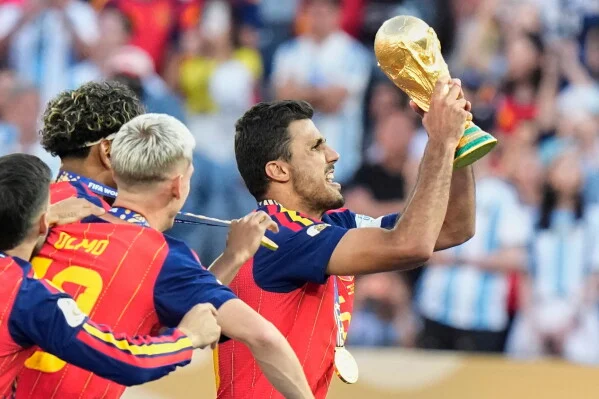
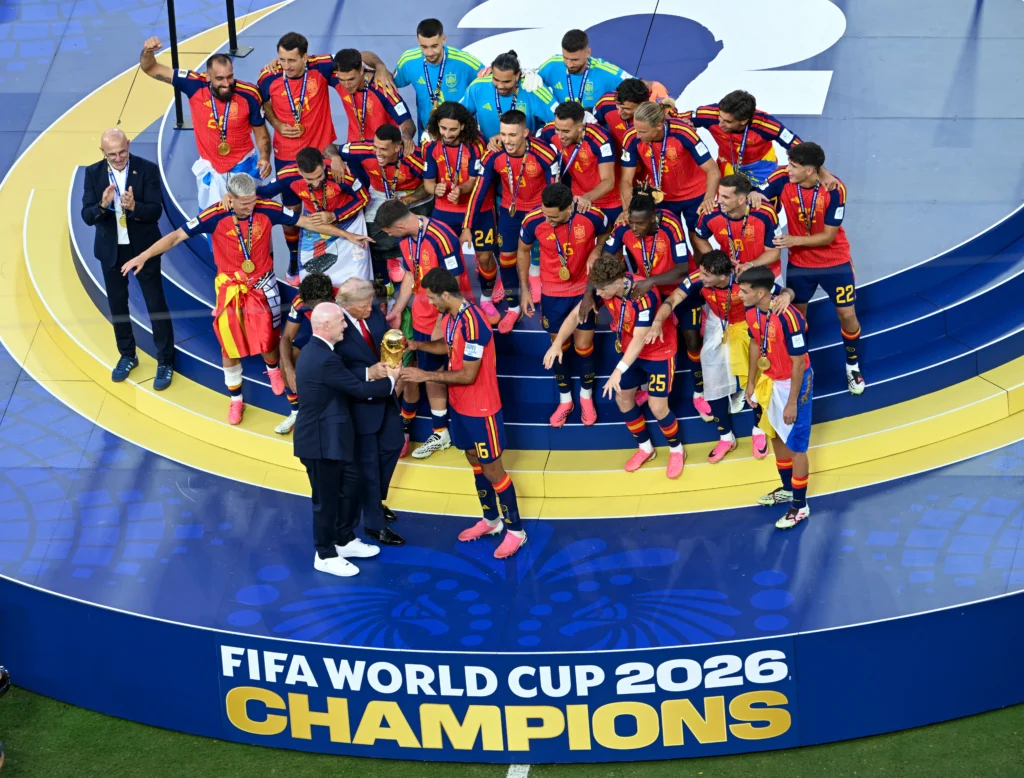
After 16 years of waiting since their historic triumph in South Africa, La Roja defeated defending champions Argentina 1-0 after extra time to win the FIFA World Cup 2026 at MetLife Stadium in East Rutherford, New Jersey. A tense and tactical final was decided in the 106th minute when substitute Ferran Torres scored the only goal of the match, ending Argentina’s reign and giving Spain their second FIFA World Cup title. The victory marks a new golden era for Spanish football. Powered by a fearless young generation led by Lamine Yamal, supported by established stars and guided by manager Luis de la Fuente, Spain completed an unbeaten tournament and once again demonstrated why possession football, tactical intelligence, and defensive discipline remain among the most effective formulas in international football.
For Argentina, the defeat brought an emotional end to another memorable World Cup campaign and possibly the final World Cup appearance of Lionel Messi, whose remarkable international career transformed Argentine football forever.
A Final That Lived Up to the Occasion
The 2026 FIFA World Cup final was billed as a clash between generations. On one side stood Lionel Messi, the legendary captain seeking consecutive World Cup titles after lifting the trophy in Qatar in 2022. On the other stood teenage sensation Lamine Yamal, already regarded as football’s brightest young talent and the face of Spain’s future. The match itself was less about spectacular attacking football and more about tactical discipline, patience, and defensive excellence. Spain controlled possession from the opening whistle, while Argentina focused on compact defending and counter-attacks.
Despite dominating territory and creating several half-chances, Spain struggled to find a breakthrough during regulation time. Argentine goalkeeper Emiliano Martínez once again produced several outstanding saves to keep his side alive. Argentina, meanwhile, found it difficult to create meaningful opportunities against Spain’s organized defensive structure. As the match entered extra time, fatigue began to appear on both sides. Then came the decisive moment.
In the 106th minute, Ferran Torres reacted quickest inside the penalty area after a loose ball bounced into space, calmly finishing past Martínez to send Spanish supporters into celebration. Argentina attempted a late comeback, but Spain defended resolutely to secure one of the most memorable victories in the nation’s football history.
Ferran Torres Delivers When It Mattered Most
Throughout the tournament, Spain relied on contributions from multiple players rather than one superstar. In the final, that philosophy proved decisive. Ferran Torres, introduced as a substitute, became the unexpected hero by scoring the winning goal.
While much of the pre-match attention focused on Yamal and Messi, it was Torres who seized the biggest moment of his career. His movement inside the box, composure under pressure, and clinical finish ensured his name will forever be remembered in Spanish football history. Great teams often produce unlikely heroes, and Torres became Spain’s latest World Cup legend.
Spain’s Young Generation Announces Its Arrival
Although Ferran Torres scored the winner, this World Cup belonged to Spain’s emerging generation. Lamine Yamal continued to display maturity beyond his years throughout the tournament, regularly troubling defenders with his creativity, pace, and confidence. Spain’s midfield once again became the heartbeat of the team, maintaining possession, dictating tempo, and frustrating opponents. The squad perfectly blended youthful energy with experienced leadership.
Unlike previous tournaments where Spain relied almost exclusively on tiki-taka, this version of La Roja showed greater tactical flexibility. They could dominate possession when needed, defend compactly against elite opposition, and attack directly during transitions. That balance made them one of the most complete teams in the tournament.
Luis de la Fuente’s Masterclass
Manager Luis de la Fuente deserves enormous credit for Spain’s success. Since taking charge, he has transformed Spain into a disciplined, confident, and adaptable side. Rather than attempting to recreate the legendary 2008-2012 generation, he built a new identity around modern football principles while preserving Spain’s technical strengths.
Throughout the World Cup, Spain consistently looked well-prepared regardless of their opponents. Whether facing physical teams, counter-attacking sides, or fellow possession-based nations, Spain always appeared tactically organized. His substitutions throughout the knockout stages repeatedly influenced matches, with Ferran Torres’ winning goal in the final becoming the ultimate example. The victory also places De la Fuente among Spain’s greatest national team coaches.
Spain’s Defensive Excellence
Championship-winning teams are often remembered for spectacular attacking football. Spain’s 2026 triumph, however, was built primarily on defensive consistency. Throughout the tournament, La Roja conceded remarkably few opportunities, with their back line maintaining excellent positioning and communication.
The defensive unit consistently protected goalkeeper Unai Simón, limiting opponents to low-quality chances. Against Argentina, Spain prevented the defending champions from establishing any sustained attacking rhythm. Their pressing forced turnovers, while their midfield shield disrupted Argentina’s build-up play. Every successful tournament needs defensive resilience, and Spain delivered exactly that.
Argentina’s Brave Campaign Ends in Heartbreak
While Spain deservedly celebrated, Argentina left the tournament with pride despite falling short. The reigning world champions once again demonstrated why they remain among football’s elite nations. Their route to the final included several impressive victories against difficult opponents. Lionel Messi continued to inspire his teammates with leadership, creativity, and determination, even as younger stars increasingly carried the physical workload.
Goalkeeper Emiliano Martínez produced another outstanding tournament and kept Argentina alive throughout the final with multiple brilliant saves. Ultimately, however, Spain’s relentless pressure proved too much. For many fans around the world, the emotional image of Messi after the final whistle symbolized the closing chapter of one of football’s greatest international careers.
Spain’s Road to the World Cup Title
Spain’s championship journey showcased consistency rather than dramatic escapes. They steadily improved as the tournament progressed, defeating strong opponents during every knockout round.
Among their notable victories were:
- Spain 3-0 Austria (Round of 32)
- Spain 1-0 Portugal (Round of 16)
- Spain 2-1 Belgium (Quarter-final)
- Spain 2-0 France (Semi-final)
- Spain 1-0 Argentina (Final, after extra time)
Each victory highlighted a different aspect of Spain’s quality:
- Against Austria, their attacking football shined
- Portugal tested their patience
- Belgium challenged their resilience
- France examined their tactical discipline
- Argentina demanded absolute composure under the greatest pressure imaginable
- Spain passed every examination
The Rise of Lamine Yamal
Few players generated as much excitement during the tournament as Lamine Yamal. Still in his teenage years, he played with the confidence of an experienced international. His dribbling, creativity, decision-making, and ability to influence matches consistently impressed fans across the globe.
Although he did not score in the final, his movement and constant threat stretched Argentina’s defence throughout the match. The tournament confirmed what many already believed: World football has found its next global superstar.
A Historic Second World Cup
Spain first conquered the world in 2010 after Andrés Iniesta’s unforgettable extra-time goal against the Netherlands. Sixteen years later, another extra-time winner has delivered another World Cup. While the 2010 team featured legends like Xavi, Iniesta, Casillas, Puyol, David Villa, and Sergio Ramos, the 2026 champions represent an entirely new generation. The achievement proves Spain’s football development system continues to produce elite talent capable of competing at the highest level. Winning a second World Cup places Spain among football’s most successful nations and reinforces their status as one of Europe’s traditional powerhouses.
What This Means for World Football
Spain’s triumph could influence international football for years to come.
Several trends emerged during the tournament:
- Young players increasingly became decisive in major matches.
- Tactical flexibility proved more valuable than rigid playing styles.
- Defensive organization remained the foundation of championship-winning teams.
- Squad depth mattered more than relying on individual brilliance.
Spain embodied each of these characteristics. With many key players still in their early twenties, they may remain among the favorites for future international tournaments, including UEFA Euro 2028 and the FIFA World Cup 2030.
The Legacy of the 2026 World Cup
The 2026 FIFA World Cup will be remembered for many reasons. It was the first tournament featuring 48 teams. It was jointly hosted by the United States, Canada, and Mexico. Attendance records were broken, global television audiences reached extraordinary levels, and football expanded its reach even further. Most importantly, it crowned a deserving champion.
Spain demonstrated consistency, resilience, tactical intelligence, and exceptional teamwork from beginning to end. Their victory represents not merely one successful tournament but the arrival of another great Spanish generation capable of shaping world football for years.
In Conclusion
Spain’s 1-0 extra-time victory over Argentina will forever occupy a special place in football history. Ferran Torres delivered the decisive goal, Luis de la Fuente masterminded another tactical triumph, and a fearless young squad announced itself as the new benchmark in international football. For Argentina, defeat was painful, but their remarkable era under Lionel Messi has already secured an immortal legacy.
For Spain, however, the future appears brighter than ever. Sixteen years after conquering the world in Johannesburg, La Roja have once again climbed football’s highest mountain. The World Cup trophy is heading back to Spain, and a new era of Spanish dominance may only just be beginning.
Also Read: Delhi Police Deny Permission for CJP’s Parliament March, Tighten Security Ahead of Monsoon Session
Frequently Asked Questions (FAQs)
Q1. Who won the FIFA World Cup 2026?
Spain won the FIFA World Cup 2026 after defeating Argentina 1-0 after extra time in the final.
Q2. Who scored the winning goal for Spain?
Substitute Ferran Torres scored the decisive goal in the 106th minute.
Q3. Where was the 2026 FIFA World Cup final played?
The final was held at MetLife Stadium in East Rutherford, New Jersey, USA.
Q4. How many World Cup titles has Spain won?
Spain has now won two FIFA World Cup titles, in 2010 and 2026.
Q5. Who coached Spain to the 2026 World Cup title?
Luis de la Fuente guided Spain to their second FIFA World Cup championship.